As on most Pacific Islands, there are very few native animals in Samoa. Because they were isolated and without human inhabitants until very recently historically, all life that evolved here came in one of three ways: wing, water, and wind. So birds are the most common and diverse animals. Sadly, many native birds on the Pacific islands have become extinct. Western ships brought with them mosquitoes (with avian malaria), and other animals, that have devastated the bird populations. Nonetheless, there are a lot of birds here, native and non-native. I especially enjoy watching the water birds, swooping low over the ocean, looking for a meal.
There and mice and rats, nearly ubiquitous throughout the world. There are still a few islands in the Pacific without them. They came with the first ships and have been one of the main threats to birds. I haven’t seen any in our house in Poutasi, but I see them occasionally in other houses, and even in the Peace Corps office. Most people have outdoor cats to control the mice and rats. There aren’t any other small animals – no squirrels, chipmunks, possums, rabbits, skunks, foxes, etc. No snakes either.
There are newts and geckos which are small, only a few inches long. The geckos come and go inside the houses and are appreciated since they eat the mosquitoes and other insects. They’re actually pretty darn cute walking up the wall on their sticky little feet. Speaking of other insects, there are flies, of course, and spiders, some quite large. The largest spider I’ve seen was about five inches across from leg tip to leg tip (do spiders have feet?). There are also lots of millipedes, an inch or so long with lots of tiny legs. They won’t hurt you, but they come out at night and it’s kind of gross to squish one with your bare foot in the dark when you’re on your way to visit the facilities. There are large centipedes which are five or six inches long and have a nasty bite that swells up. Fortunately, I’ve never been bitten, but a lot of Peace Corps volunteers have. There are some pretty good sized cockroaches (maybe two inches long), but they are easily controlled with some insect spray, especially in a western-style house like I live in. And there are small ants always and everywhere.
The only native mammal is the fruit bat. The Polynesians, who came here in canoes 3,000 years ago, brought with them chickens, dogs, and pigs. Chickens roam freely, but they go home to roost at night in the trees at the family compound. Families feed them rice or shredded coconut – not much, just enough so they know where home is. The chickens are very pretty. The roosters are usually multi-colored with iridescent blue-green and brown and gold feathers. I saw one chicken in the village that was white with black spots, just like a Dalmatian. The little chicks are delightful to watch as the follow their mother around the yard learning to scratch for food.
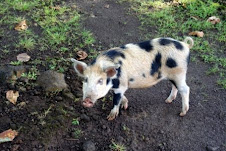
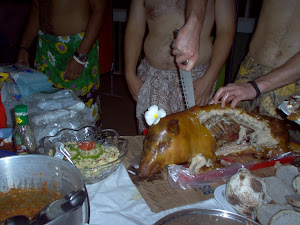
Some pigs are fenced in, but others roam, rooting around for food, and like the chickens, know where home is. They’re fed fruit like papayas or green bananas, and leftover vegetable matter (peels, squash rinds, etc.) The pigs that aren’t fenced in are really quite a nuisance and gardens must be fenced to keep the pigs out. There are also wild pigs. Some families have cattle – maybe a small herd or maybe just one (cows aren’t milked). Both pigs and cattle are like currency and the number of pigs and cattle that you have are a sign of wealth. Fines are levied in the village for breaking village rules and payment is often a pig to the chiefs. At ceremonial occasions, such as weddings, funerals, or any special event, roast pigs are brought to present to the honored guests. The larger the pig, the larger the honor bestowed. And if a cow is butchered and given to the honored guests, it is deemed to be a special tribute.
Horses are used to get to and from the farmlands just outside the village, and to carry produce, or otherwise as beasts of burden. They are ridden with many strands of grasses about four feet long bunched together and laid over their backs with a small blanket on top of the grass. Looks very comfy; they aren’t going anywhere in a hurry. There are a few sheep here, but they are new in the country and are on experimental farms.
The only other animals are the dogs. There are a lot of them and they are mostly pests, not pets. There are occasionally dogs that remind you of a recognized dog breed somewhere in their distant lineage, but most are a standard mutt, usually light brown with occasionally some black or white coloring, short hair, with a slender build, and some are dreadfully skinny. Surplus dogs fend for themselves and roam around in packs. Many Peace Corps volunteers have been bitten by dogs (not me, knock on wood). Although I’ve had a moment or two of worry while I stood my ground and shouted, while pretending to pick up a rock and throw it at them. There weren’t any rocks nearby, or I would have actually done it. Nearly every family has three or four watch dogs who are profoundly territorial. At night there are a lot of dog fights. Almost every dog has some remnant of an injury – a lame leg, a torn ear. The female dogs are always pregnant or nursing. I don’t know what they do with the surplus puppies, and I don’t want to know. With few exceptions, dogs aren’t neutered and are abused. They are routinely kicked if they’re in the wrong place at the wrong time. They are never petted. One of our dogs died last week, apparently of poisoning. Not intentional probably. He likely got into some insecticide or something. It was awful to see him suffer for hours and then die. Of course in the states, he would have been rushed to the vet, but there was no vehicle that day to take him to Apia, and they wouldn’t have anyway. So it was just, “He’s dying.” And so he did.
There’s a new puppy now, cute as a button, and about the size of a fat cat. I already hear him yelping occasionally from the lesson of the swift kick when he wants to come into the house. It’s hard to get accustomed to that. I told the family here that my dog in America stays in the house and sleeps on my bed, and they literally just looked at me and didn’t say a thing. I think it was simply incomprehensible.
Wednesday, February 13, 2008


Friday, December 28, 2007

What is life like in my Samoan village?
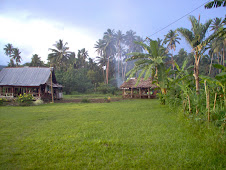
So what is life like in the village? Background info . . . . Apia is the only town/city in Samoa. It has about 35,000 people and the rest of the population of the country of 180,000 people live in small villages, mostly along the coastlines. My village of Poutasi has a population of 325±. On the map I’ve made of the village there are 50 family compounds some of which house one nuclear family and others an extended family. It is a lovely village – pleasing to the eye. About half of the homes, including mine, are located on the ocean and the other half up the mountain a little ways. Some of the houses are very Western in style, others are the traditional open thatched-roof fales, and most are something in between.
Some of the men and women work outside of the village during the day – in offices or shops in Apia or as school teachers, etc. Most of the women stay at home and care for the family and many men also work on their family farms or fish instead of working elsewhere. Less than half of the families have vehicles. Most people ride the bus.
A general answer to the question would be “quiet.” The only sounds normally are the muffled roar of the surf on the fringing reef, which quickly becomes white noise, roosters crowing, dogs barking, birds singing, and usually music playing somewhere. On a daily basis people go about their normal activities. For the women this would be sewing, cleaning, cooking, weaving, child care, etc. Actually cooking takes up a great deal of time. Most people, including the family that I live with, still cook on open fires or in underground ovens with hot rocks in back of the main house (we have a one-burner propane cook top inside too). The men will go fishing or to their farm, which is up the mountain a little ways. That’s usually early in the morning or when it begins to cool off late in day. In the afternoon the women will often gather in the women’s committee house (an open fale) to talk, weave, play cards, or sleep.
Church and bingo are the two big activities of the week in the village. There are two churches in the village – Catholic and Congregational (the church of the missionaries which is descended from the Puritans, if I remember correctly). There are two church services on Sunday, not including Sunday School and the Youth Group meeting after church Sunday evening. There are usually one or two other church activities during the week too, such as choir practice or the women’s fellowship. Bingo is in the church hall and is a fund raiser for the church – very well-attended!
My life in the village will always be mostly unstructured, but is probably a little more so right now because I’m still settling in and not working very aggressively on any projects yet. But this is my “routine” at this point. I wake up about 6:30 and go for a walk on the road along the ocean in the cool of the day. Then I make breakfast etc. and figure out what I’m going to do for the day. If it’s Sunday I go to church. I usually go to the Congregational Church since it reminds me of the church where I went when I was young. My Samoan family also goes there. But every now and then I go to the Catholic service to make sure I continue to get acquainted with everyone in the village. It’s really important for us to go to church since it’s such an important part of village life. On Sunday there is nothing else to do since it’s a day of rest. We come home, eat a big meal and sleep and relax until the afternoon service. In addition to not working, on Sunday there is no swimming allowed and the young people don’t play rugby or volleyball like the usually do in the afternoons.
For these first few months in the village our primary “job” is to get to know the village and the people. So what I do each day varies from visiting the primary and secondary schools, going to village meetings of the chiefs or the women’s committee, to just studying the language. Sometimes I go and visit with the women in the committee house in the afternoon. And some days I just stay at home and read or write. I usually write some each day. Lately I’ve also been reading some sample proposals from other Peace Corps projects and making phone calls to set up appointments to get information about some of the proposed projects for the village. Nearly every afternoon I sit in the open fale next to the ocean and read or write, watch the fishermen or the children playing in the sea, and watch the sunset (always spectacular!). In the evening I read, watch dvd’s, play computer games, listen to Radio Australia (like NPR), etc. The family I live with has a TV, but there’s not much to watch.
After the holidays I’ll be starting to work in earnest on funding for the Learning Centre and an environmental project along the river bank and sea shore as well as some community gardens. It’s a process.
Some of the men and women work outside of the village during the day – in offices or shops in Apia or as school teachers, etc. Most of the women stay at home and care for the family and many men also work on their family farms or fish instead of working elsewhere. Less than half of the families have vehicles. Most people ride the bus.
A general answer to the question would be “quiet.” The only sounds normally are the muffled roar of the surf on the fringing reef, which quickly becomes white noise, roosters crowing, dogs barking, birds singing, and usually music playing somewhere. On a daily basis people go about their normal activities. For the women this would be sewing, cleaning, cooking, weaving, child care, etc. Actually cooking takes up a great deal of time. Most people, including the family that I live with, still cook on open fires or in underground ovens with hot rocks in back of the main house (we have a one-burner propane cook top inside too). The men will go fishing or to their farm, which is up the mountain a little ways. That’s usually early in the morning or when it begins to cool off late in day. In the afternoon the women will often gather in the women’s committee house (an open fale) to talk, weave, play cards, or sleep.
Church and bingo are the two big activities of the week in the village. There are two churches in the village – Catholic and Congregational (the church of the missionaries which is descended from the Puritans, if I remember correctly). There are two church services on Sunday, not including Sunday School and the Youth Group meeting after church Sunday evening. There are usually one or two other church activities during the week too, such as choir practice or the women’s fellowship. Bingo is in the church hall and is a fund raiser for the church – very well-attended!
My life in the village will always be mostly unstructured, but is probably a little more so right now because I’m still settling in and not working very aggressively on any projects yet. But this is my “routine” at this point. I wake up about 6:30 and go for a walk on the road along the ocean in the cool of the day. Then I make breakfast etc. and figure out what I’m going to do for the day. If it’s Sunday I go to church. I usually go to the Congregational Church since it reminds me of the church where I went when I was young. My Samoan family also goes there. But every now and then I go to the Catholic service to make sure I continue to get acquainted with everyone in the village. It’s really important for us to go to church since it’s such an important part of village life. On Sunday there is nothing else to do since it’s a day of rest. We come home, eat a big meal and sleep and relax until the afternoon service. In addition to not working, on Sunday there is no swimming allowed and the young people don’t play rugby or volleyball like the usually do in the afternoons.
For these first few months in the village our primary “job” is to get to know the village and the people. So what I do each day varies from visiting the primary and secondary schools, going to village meetings of the chiefs or the women’s committee, to just studying the language. Sometimes I go and visit with the women in the committee house in the afternoon. And some days I just stay at home and read or write. I usually write some each day. Lately I’ve also been reading some sample proposals from other Peace Corps projects and making phone calls to set up appointments to get information about some of the proposed projects for the village. Nearly every afternoon I sit in the open fale next to the ocean and read or write, watch the fishermen or the children playing in the sea, and watch the sunset (always spectacular!). In the evening I read, watch dvd’s, play computer games, listen to Radio Australia (like NPR), etc. The family I live with has a TV, but there’s not much to watch.
After the holidays I’ll be starting to work in earnest on funding for the Learning Centre and an environmental project along the river bank and sea shore as well as some community gardens. It’s a process.
The Bamboo Cannon

The last couple of evenings in the village I've been hearing the Samoan version of fireworks to celebrate Christmas. The “fireworks” are muffled booms – well, not so muffled if you’re up close. From my house, maybe the length of a football field away, it sounds like the noise made when fireworks are launched at a fireworks show. I went to see what was going on and saw three boys, about ten years old, having fun with fire. Here’s how they do it. Envision a stalk of dried bamboo about four to five feet long and four to six inches in diameter. Make a one-inch diameter hole in the end section, then pour in a small amount of kerosene. Fresh air is blown into the hole to activate the fumes. Then they light the gas from the top of the hole with a small flaming stick kept in the coconut husk fire nearby. Poof! Bang! And a flame shoots up a couple of feet in the air. Again, and again, with a small explosion about every five seconds. It takes some practice to make the loudest bang. It's called a "bamboo cannon" and ironically the children use it as an alternative to commerical, dangerous, fireworks which are illegal in Samoa.
Wednesday, October 31, 2007
Watching the Fishermen
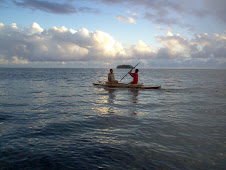
This afternoon I’ve been watching several young men from the village fishing in the sea in front of my fale. The water inside the reef is so shallow that you can walk all the way to the reef (about ½ mile) in water only about waist deep. It’s crystal clear – like a huge swimming pool with no deep end. There are seven of them in their 20’s, bare to the waist with their traditional lavalavas tied a little shorter than usual to give them more agility in the water. Two men are holding the net – imagine a rectangle about 20 feet long and six feet wide. One is paddling in a traditional dugout outrigger canoe which is painted a bright turquoise – a brilliant contrast and compliment to the aquamarine sea. They walk along in the water looking for fish. Two of them have spears and some carry sticks. When they spot fish, they point in that direction and the men with the net begin to ease up toward them. When they are in position, the others run toward the net, beating the water with their hands and the sticks, shouting, chasing the fish toward the net. Occasionally one of the men leaps out of the water and dives forward, face down into the water, arms outstretched, scaring the fish toward the net. Then they all charge to the net trying to spear the fish or hit them with the sticks to stun them to be able to get them out of the water and into the canoe. In between, as they walk along, they sometimes push each other into the water, or throw their sticks into the air and try to catch them on the way down, just like young men everywhere. Two young boys about 10 or 12 years old float on pieces of salvaged wood a little distance away – watching, learning, When they finish fishing for the day they will divide the catch amongst themselves, and maybe share with other families depending upon the success of the day.
This morning I also watched a mother and her children walking in the water inside the reef looking for sea cucumbers, clams, or other shell fish. When they spotted something they would go under the water to gather it up. The boy, about 7 or 8 years old, alternately pulled along, and floated on, a white plastic bucket in which they placed their catch. When I saw them go out, I thought it would be interesting and maybe fun to go with them some time, but they were out there for about two hours in the water and the direct overhead sun beating down. It is after all, dinner, not amusement.
This morning I also watched a mother and her children walking in the water inside the reef looking for sea cucumbers, clams, or other shell fish. When they spotted something they would go under the water to gather it up. The boy, about 7 or 8 years old, alternately pulled along, and floated on, a white plastic bucket in which they placed their catch. When I saw them go out, I thought it would be interesting and maybe fun to go with them some time, but they were out there for about two hours in the water and the direct overhead sun beating down. It is after all, dinner, not amusement.
Polynesia
In Samoa (and in the rest of the South Pacific) Hawaii is not considered part of the United States. Of course they know that it is politically, but in ordinary conversation they are mutually exclusive. So I say that I’m from Hawaii and not from America (Amelika is the word for USA). It makes sense when one thinks about it. Hawaii was part of their culture and civilization long before it was part of our country. Hawaii’s culture is still very different from most of the U S of course. I think that one of the reasons that people enjoy vacationing there so much is that it’s “exotic” and feels like a foreign country in many ways, but has the benefit of being part of the U S.
All of the islands of Samoa put together (1,133 square miles) are about one-fourth of the size of the Big Island of Hawaii. The island that I live on here, Upolu, is roughly 50 miles long and 15 miles wide (about the same shape as the island of Molokai, which is about 30 miles long and about 6 miles wide).
The other major island, Savai’i, is also called the Big Island (I haven’t been there yet, but I’ll definitely go there). Samoans are convinced that Hawai’i is named for Savai’i, but historically everything I’ve read contradicts that. The Hawaiians came from the Marquesas between 300 and 1,000 CE with some later migrations from Tahiti. Samoa was settled about 3,000 years ago as part of the Polynesian migrations that began in Asia and continued throughout the Pacific. Polynesia is the term used for Pacific Islanders with similar ethnic and linguistic characteristics and close affinities to Malay people.
Samoa and Hawai’i are much alike in food, language, plants, and even the physical characteristics and society of the people. Someone in Hawai’i told me before I left to come here, that Samoa was like Hawai’i in the 1920’s or 30’s. That’s probably pretty close. Except for some of the modern conveniences like the internet, cell phones, and television.
Those same modern culture influences are some of the things challenging the country of Samoa today. The culture is still very religious, conservative, and modest. It’s difficult, especially for parents and teachers, when the children are exposed to American TV and movies, and god-knows-what on the internet. It’s not unlike some of the complaints that Islamic people have about Western countries. Religion here is kind of like that of Islamic nations. Not the theology of course, but the pervasiveness of it. It is not something that people do. It is who they are. It isn’t a place they go on Sundays, but an integral part of life everyday. Every public event includes a prayer to Atua (God). Nearly every article in the newspaper references Atua, even on the sport‘s pages. Everyday conversation and every meeting of any kind includes Atua. To eat a meal anywhere without saying “grace” is unthinkable. The country’s motto is “Samoa is founded on God.” And it clearly is. The missionaries who came in 1830 would be very pleased to know how successful they were.
All of the islands of Samoa put together (1,133 square miles) are about one-fourth of the size of the Big Island of Hawaii. The island that I live on here, Upolu, is roughly 50 miles long and 15 miles wide (about the same shape as the island of Molokai, which is about 30 miles long and about 6 miles wide).
The other major island, Savai’i, is also called the Big Island (I haven’t been there yet, but I’ll definitely go there). Samoans are convinced that Hawai’i is named for Savai’i, but historically everything I’ve read contradicts that. The Hawaiians came from the Marquesas between 300 and 1,000 CE with some later migrations from Tahiti. Samoa was settled about 3,000 years ago as part of the Polynesian migrations that began in Asia and continued throughout the Pacific. Polynesia is the term used for Pacific Islanders with similar ethnic and linguistic characteristics and close affinities to Malay people.
Samoa and Hawai’i are much alike in food, language, plants, and even the physical characteristics and society of the people. Someone in Hawai’i told me before I left to come here, that Samoa was like Hawai’i in the 1920’s or 30’s. That’s probably pretty close. Except for some of the modern conveniences like the internet, cell phones, and television.
Those same modern culture influences are some of the things challenging the country of Samoa today. The culture is still very religious, conservative, and modest. It’s difficult, especially for parents and teachers, when the children are exposed to American TV and movies, and god-knows-what on the internet. It’s not unlike some of the complaints that Islamic people have about Western countries. Religion here is kind of like that of Islamic nations. Not the theology of course, but the pervasiveness of it. It is not something that people do. It is who they are. It isn’t a place they go on Sundays, but an integral part of life everyday. Every public event includes a prayer to Atua (God). Nearly every article in the newspaper references Atua, even on the sport‘s pages. Everyday conversation and every meeting of any kind includes Atua. To eat a meal anywhere without saying “grace” is unthinkable. The country’s motto is “Samoa is founded on God.” And it clearly is. The missionaries who came in 1830 would be very pleased to know how successful they were.
Meeting of the Chiefs
I went to a matai council meeting in the village this week. The social structure of Samoa is based on the matai system which has been the way of life here for centuries. The matai system is intertwined with the basic unit of Samoan society, the ‘aiga, or family. The family in Samoa is a very comprehensive term, including the nuclear family; members of the (very) extended family, and their spouses and children; and persons “adopted” into the family. The matai heads the ‘aiga.
Families form the village community. A village is largely a self-governing unit controlled by the village council composed of the matai. There is also a village mayor but his role is primarily as a liaison to the national government. The matai council makes all the decisions and set the rules for the village. For example, some of the rules in my village include no beer drinking in the village, no facial hair for men, and use of only traditional fishing methods.
Matai are divided into orators (talking chiefs) and chiefs. It is the duty of the orators to understand local history and tradition and to be able to use a special variation of the Samoan language only used on formal occasions. Maybe some other time I’ll write more about the history and traditions.
The chiefs are given positions of respect and participate along with the orators in decision making and village politics. Depending upon their status, they may sway the decisions made by the village council in one direction or another. Each village usually has one or two “high chiefs” whose rank exceeds that of the other matai.
Apart from obligations to the village, the most important duty of every matai is to look after the family (which may be dozens of people). The matai controls the family land and allocates its use. Family members serve the matai by cooking food and cultivating crops. In turn, they receive food, lodging, and money as needed. Family members living away from the matai (even in other countries) may be called upon to make contributions of food or money for church or family functions.
Although the matai system may resemble a feudal baron who gave serfs protection in return for the services, the system differs in one important respect. Family members have a strong say in who becomes the matai. Usually direct heirs are the first to be considered, but they are not always successful. Samoan’s have a saying, “O le ala i le pule o le tautua.” – “Service is the way to power.” Frequently one who has served the matai faithfully succeeds him. Discussions regarding matai titles are made on a consensual basis and sometimes difficult to reach. Occasionally a woman may be made a matai, but usually they are men.
Not all matai live up to the standards set by the system. Members of the family can express dissatisfaction and seek removal of the title, but this is rare. Like positions of leadership worldwide, some are active leaders, some are active followers, and some are along just for the ride.
So here’s what a matai council meeting looks like. The matai are seated cross-legged) on the floor of an open fale, a large one, maybe 40 or 50 feel long, which is the one designated for village council meetings. An “open fale” is a raised (two or three feet high) concrete foundation with posts from floor to ceiling averaging about ten inches in diameter and spaced about four feet apart. The sloping roof is galvanized metal nowadays, often painted a rusty red color, but was coconut frond thatch in the past. There is an overhang of a few feet all around.
The early birds get a post, but there are also designated seating arrangements. The high chief(s) sit at the end, and the highest orators are seated on one of the long sides. The rest of the matai are seated along the other side.
At the beginning of each meeting there is an ava ceremony. Some of you have heard of ava, or kava, as it’s called some places in the Pacific. Samoan ava is notoriously weak, so if you’ve experienced it elsewhere, it may have had more of a “punch” than Samoan ava. Ava is a drink made from the dried and pulverized root of a plant (piper methysticum). I hadn’t tasted it before I came to Samoa, although I had seen it in Hawaii. It tastes and looks kind of like dishwater. Not that I’ve made a practice of drinking dishwater, but I think have a general idea of what that tastes like! There is a specialized ritual which can be longer or shorter depending upon the occasion. For a matai meeting, there are three untitled young men (usually in their 20’s or 30’s) who sit on a fala mat, with one of the matai. They sit a few feet in front of the long row of matai whose backs are to the posts. The ava is in a wooden bowl that stands on little carved legs all around the edges of the bowl. One of the young men sits behind the bowl. Another serves the ava in half of a coconut shell. The third young man calls out the ceremonial ritual, directing the service of the ava in the appropriate order according to rank. I am served after the high chief (whom I also sit beside at the end of the fale).
When given the cup of ava, the proper procedure is to pour out a drop or two on the mat beside you while saying, “Lau ava lea le Atua.” – “God, here is your ava.” Then you say, “Soifua!” or “Manuia!” – which basically means “Good health to you!” Then you drink it and give the cup back to the server. You take only one drink. If you don’t finish it all in one drink, you toss the remainder in the cup out of the fale over your shoulder.
So besides the taste, what is ava like? I have only had these small sips (at five ceremonies since I’ve been here), but I’m told that if you drink a lot of it your tongue and lips will get sort of numb (it is part of the pepper family) and that it is a general relaxant. It’s not intoxicating like alcohol.
After the ava ceremony the chief orator begins the meeting with the appropriate honorifics and traditional language, always including thanks to God. And then they commence with the business of the day. Decisions are made by consensus and every opinion is heard and discussed. A simple majority is not used to make a decision. Whoever wishes to speak on a subject may do so (often at great length) and without interruption.
Families form the village community. A village is largely a self-governing unit controlled by the village council composed of the matai. There is also a village mayor but his role is primarily as a liaison to the national government. The matai council makes all the decisions and set the rules for the village. For example, some of the rules in my village include no beer drinking in the village, no facial hair for men, and use of only traditional fishing methods.
Matai are divided into orators (talking chiefs) and chiefs. It is the duty of the orators to understand local history and tradition and to be able to use a special variation of the Samoan language only used on formal occasions. Maybe some other time I’ll write more about the history and traditions.
The chiefs are given positions of respect and participate along with the orators in decision making and village politics. Depending upon their status, they may sway the decisions made by the village council in one direction or another. Each village usually has one or two “high chiefs” whose rank exceeds that of the other matai.
Apart from obligations to the village, the most important duty of every matai is to look after the family (which may be dozens of people). The matai controls the family land and allocates its use. Family members serve the matai by cooking food and cultivating crops. In turn, they receive food, lodging, and money as needed. Family members living away from the matai (even in other countries) may be called upon to make contributions of food or money for church or family functions.
Although the matai system may resemble a feudal baron who gave serfs protection in return for the services, the system differs in one important respect. Family members have a strong say in who becomes the matai. Usually direct heirs are the first to be considered, but they are not always successful. Samoan’s have a saying, “O le ala i le pule o le tautua.” – “Service is the way to power.” Frequently one who has served the matai faithfully succeeds him. Discussions regarding matai titles are made on a consensual basis and sometimes difficult to reach. Occasionally a woman may be made a matai, but usually they are men.
Not all matai live up to the standards set by the system. Members of the family can express dissatisfaction and seek removal of the title, but this is rare. Like positions of leadership worldwide, some are active leaders, some are active followers, and some are along just for the ride.
So here’s what a matai council meeting looks like. The matai are seated cross-legged) on the floor of an open fale, a large one, maybe 40 or 50 feel long, which is the one designated for village council meetings. An “open fale” is a raised (two or three feet high) concrete foundation with posts from floor to ceiling averaging about ten inches in diameter and spaced about four feet apart. The sloping roof is galvanized metal nowadays, often painted a rusty red color, but was coconut frond thatch in the past. There is an overhang of a few feet all around.
The early birds get a post, but there are also designated seating arrangements. The high chief(s) sit at the end, and the highest orators are seated on one of the long sides. The rest of the matai are seated along the other side.
At the beginning of each meeting there is an ava ceremony. Some of you have heard of ava, or kava, as it’s called some places in the Pacific. Samoan ava is notoriously weak, so if you’ve experienced it elsewhere, it may have had more of a “punch” than Samoan ava. Ava is a drink made from the dried and pulverized root of a plant (piper methysticum). I hadn’t tasted it before I came to Samoa, although I had seen it in Hawaii. It tastes and looks kind of like dishwater. Not that I’ve made a practice of drinking dishwater, but I think have a general idea of what that tastes like! There is a specialized ritual which can be longer or shorter depending upon the occasion. For a matai meeting, there are three untitled young men (usually in their 20’s or 30’s) who sit on a fala mat, with one of the matai. They sit a few feet in front of the long row of matai whose backs are to the posts. The ava is in a wooden bowl that stands on little carved legs all around the edges of the bowl. One of the young men sits behind the bowl. Another serves the ava in half of a coconut shell. The third young man calls out the ceremonial ritual, directing the service of the ava in the appropriate order according to rank. I am served after the high chief (whom I also sit beside at the end of the fale).
When given the cup of ava, the proper procedure is to pour out a drop or two on the mat beside you while saying, “Lau ava lea le Atua.” – “God, here is your ava.” Then you say, “Soifua!” or “Manuia!” – which basically means “Good health to you!” Then you drink it and give the cup back to the server. You take only one drink. If you don’t finish it all in one drink, you toss the remainder in the cup out of the fale over your shoulder.
So besides the taste, what is ava like? I have only had these small sips (at five ceremonies since I’ve been here), but I’m told that if you drink a lot of it your tongue and lips will get sort of numb (it is part of the pepper family) and that it is a general relaxant. It’s not intoxicating like alcohol.
After the ava ceremony the chief orator begins the meeting with the appropriate honorifics and traditional language, always including thanks to God. And then they commence with the business of the day. Decisions are made by consensus and every opinion is heard and discussed. A simple majority is not used to make a decision. Whoever wishes to speak on a subject may do so (often at great length) and without interruption.
Wednesday, October 10, 2007
The First Weeks in Poutasi
Tomorrow I will have been in Poutasi for seven weeks. As I knew it would, life here gets easier every day. Although I still miss the privacy of having my own house, my host family is very kind and I like them. I’m gradually learning the names of people in the village and actually starting to remember some of them when I see them.
I’m still challenged with understanding the spoken language much of the time, but that will come with practice. People in the village tell me all the time how well I speak Samoan.
For those of you familiar with the Hawaiian language, you know how subtle the nuances are, especially in Polynesian languages where the words are mostly vowels. For example:
ia (ē’-ah) means “he, she or it,” “these” or adds an emphasis which means “this one and no other” (Ia a’u? Ia oe! = Do you mean me? Yes, you!) Spoken with a rising tone and a glottal stop at the end, it means “very well then” or “all right then.”
‘ia (note the inverted comma which indicates a glottal stop making the i (ē) a short sound) means “in order to” or “yes.”
‘iā (note the macron indicating the vowel sound is held longer) can mean “in, at, on, for” depending on the context. ‘Iā is also the command given at the start of a race like, “Ready, set, go!”
and i’a means “fish.”
It's hugely contextual as you can tell!
My job for the first few months here is to get to know the village. I’m creating a village map and writing a report called the Village Situational Analysis which will compile info about the village such as population statistics (I’ll be doing a house-to-house survey), environmental overview, economic and agricultural assessment, health and school issues, community resources, etc. Although I have already been told about some of the projects that they would like me to do, this analysis will help to focus on possible projects and activities and the resources necessary to accomplish them.
So I’m not busy all day long. Actually, if I accomplish one Peace Corps related project each day I’m satisfied at this point. It may be attending a village meeting or church service or just studying the language. I’m sometimes torn between wanting to get started and charge ahead with some of the projects, and yet knowing that it’s best to understand the village, the personalities, the resources, etc. before I can expect to be successful. It’s important that it not be “my project,” but the village’s project.
So I’m doing a lot of reading, which I never get tired of, and writing. I started working on a garden this week. I’m learning to have more patience, which has never been one of my strengths.
I’m still challenged with understanding the spoken language much of the time, but that will come with practice. People in the village tell me all the time how well I speak Samoan.
For those of you familiar with the Hawaiian language, you know how subtle the nuances are, especially in Polynesian languages where the words are mostly vowels. For example:
ia (ē’-ah) means “he, she or it,” “these” or adds an emphasis which means “this one and no other” (Ia a’u? Ia oe! = Do you mean me? Yes, you!) Spoken with a rising tone and a glottal stop at the end, it means “very well then” or “all right then.”
‘ia (note the inverted comma which indicates a glottal stop making the i (ē) a short sound) means “in order to” or “yes.”
‘iā (note the macron indicating the vowel sound is held longer) can mean “in, at, on, for” depending on the context. ‘Iā is also the command given at the start of a race like, “Ready, set, go!”
and i’a means “fish.”
It's hugely contextual as you can tell!
My job for the first few months here is to get to know the village. I’m creating a village map and writing a report called the Village Situational Analysis which will compile info about the village such as population statistics (I’ll be doing a house-to-house survey), environmental overview, economic and agricultural assessment, health and school issues, community resources, etc. Although I have already been told about some of the projects that they would like me to do, this analysis will help to focus on possible projects and activities and the resources necessary to accomplish them.
So I’m not busy all day long. Actually, if I accomplish one Peace Corps related project each day I’m satisfied at this point. It may be attending a village meeting or church service or just studying the language. I’m sometimes torn between wanting to get started and charge ahead with some of the projects, and yet knowing that it’s best to understand the village, the personalities, the resources, etc. before I can expect to be successful. It’s important that it not be “my project,” but the village’s project.
So I’m doing a lot of reading, which I never get tired of, and writing. I started working on a garden this week. I’m learning to have more patience, which has never been one of my strengths.
Tuesday, September 4, 2007
The Move to Poutasi
September 4, 2007
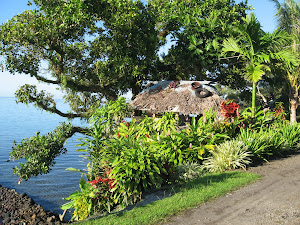
It turns out that I will be living with a family in Poutasi across the road from the fale by the sea where I was originally supposed to live; the small fale will be available for me to work in, relax and read, and have meetings, etc. That will probably rescue me in the moments that I am discouraged. I have been over there nearly every day. The sea is soothing and calming in the way that it has been for millennia. The family that I am living with is very warm and welcoming.
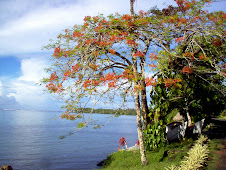
With all of the anxiety I’ve been feeling about moving to a new village and meeting all the new people there – which is dissipating somewhat already – it’s good to remember how fortunate it is that I’m in such a beautiful place! I could be in a cold, dreary place or one that is hot and dusty and drab. This is exactly where I wanted to be. I am writing this on my laptop and will save it to my flashdrive to take to town to post on my blog. At this moment I’m sitting in the fale by the sea listening to the birds twittering in the nonu bushes, kingfishers, I think, and to the constant chattering of the coconut palm fronds as they rise and fall in the breeze. I hear the steady roar of the surf as it crashes over and over the fringing reef of the island, maybe a half mile away (I’m not good at judging distances, especially over water.). The small waves reaching the shore about 20 feet in front of me lap a continuous beat of their own. The pounding surf sounds like a waterfall upstream, ebbing and flowing slightly, but never stopping, with the small waves like a babbling brook beside me. The sound of the surf is faint enough that one can easily not hear it because you quickly become accustomed to the “white noise.” But it is always there, loud enough to be clearly heard, even from my room in the house when I stop and listen.
The ocean just about 20 feet in front of me is varying shades of blue and aqua. The Samoan word for the color blue is lanumoana, which literally means the color of the deep ocean. It is clean and clear and only about waist deep in most places all the way out to the reef. A couple of mornings I have gone for a short swim after my morning walk.
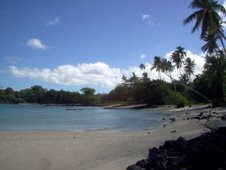
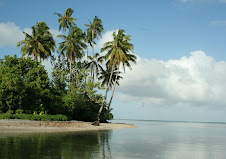
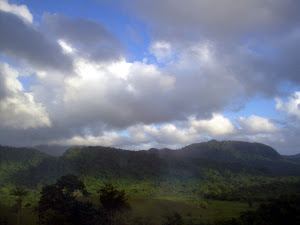
I’m looking between the palms in front of the fale at Nuu Safee Island. The island is owned by the village. It is a small uninhabited island that one can go to for a day trip by boat (I haven’t yet, but I’m looking forward to it). Sometimes visitors “rent” the island and stay there for a few days. It is the postcard version of a Pacific Island fringed by coconut palms with a wide white coral beach. The sun is slowly setting leaving a shining path on the sea. As it sinks behind the clouds, the forest below on the horizon becomes a silhouette with the tallest palms in stark relief above the tree canopy. Soon the brightness will fade to pinks and oranges as it disappears for the night. Behind me the tops of the mountain ridges are covered with clouds whose edges look like puffs of cotton. I suspect it’s raining at the summit.
There is a cool breeze blowing my troubles away – blowing them out to sea so that I can replace them with loving, calm, serene, and confident thoughts that I am being sent from my family and friends back home. Fa’afetai!
It turns out that I will be living with a family in Poutasi across the road from the fale by the sea where I was originally supposed to live; the small fale will be available for me to work in, relax and read, and have meetings, etc. That will probably rescue me in the moments that I am discouraged. I have been over there nearly every day. The sea is soothing and calming in the way that it has been for millennia. The family that I am living with is very warm and welcoming.
With all of the anxiety I’ve been feeling about moving to a new village and meeting all the new people there – which is dissipating somewhat already – it’s good to remember how fortunate it is that I’m in such a beautiful place! I could be in a cold, dreary place or one that is hot and dusty and drab. This is exactly where I wanted to be. I am writing this on my laptop and will save it to my flashdrive to take to town to post on my blog. At this moment I’m sitting in the fale by the sea listening to the birds twittering in the nonu bushes, kingfishers, I think, and to the constant chattering of the coconut palm fronds as they rise and fall in the breeze. I hear the steady roar of the surf as it crashes over and over the fringing reef of the island, maybe a half mile away (I’m not good at judging distances, especially over water.). The small waves reaching the shore about 20 feet in front of me lap a continuous beat of their own. The pounding surf sounds like a waterfall upstream, ebbing and flowing slightly, but never stopping, with the small waves like a babbling brook beside me. The sound of the surf is faint enough that one can easily not hear it because you quickly become accustomed to the “white noise.” But it is always there, loud enough to be clearly heard, even from my room in the house when I stop and listen.
The ocean just about 20 feet in front of me is varying shades of blue and aqua. The Samoan word for the color blue is lanumoana, which literally means the color of the deep ocean. It is clean and clear and only about waist deep in most places all the way out to the reef. A couple of mornings I have gone for a short swim after my morning walk.
I’m looking between the palms in front of the fale at Nuu Safee Island. The island is owned by the village. It is a small uninhabited island that one can go to for a day trip by boat (I haven’t yet, but I’m looking forward to it). Sometimes visitors “rent” the island and stay there for a few days. It is the postcard version of a Pacific Island fringed by coconut palms with a wide white coral beach. The sun is slowly setting leaving a shining path on the sea. As it sinks behind the clouds, the forest below on the horizon becomes a silhouette with the tallest palms in stark relief above the tree canopy. Soon the brightness will fade to pinks and oranges as it disappears for the night. Behind me the tops of the mountain ridges are covered with clouds whose edges look like puffs of cotton. I suspect it’s raining at the summit.
There is a cool breeze blowing my troubles away – blowing them out to sea so that I can replace them with loving, calm, serene, and confident thoughts that I am being sent from my family and friends back home. Fa’afetai!
Leaving Manunu
August 17, 2007
It is absolutely amazing to realize that we have nearly completed our training, and be sworn in as official Peace Corps volunteers on Wednesday. It has been tough, but has gone by so quickly. We are in for a big change that will be perhaps more challenging than what we’ve experienced thus far. Going to our new villages on August 23rd and adapting to a new lifestyle - no more structured training calendars, meeting a whole village of new people, and starting the "job" part of our Peace Corps experience will be difficult in many ways. Nonetheless, we have gotten this far and have been given tools to use. That’s what the sometimes grueling training has been for.
Last Sunday morning the congregation of the church in our training village began to say goodbye to us. I read in Samoan, a prayer of thanks. Compared to the few words I was able to say on that very first Sunday here, even I am impressed with my abilities. (I passed our final language test at the advanced level last week - I was pleasantly surprised.) Like on our first Sunday, when we we all went to the front of the church to be welcomed, we did that again. Only this time we knew everyone who gave us a hug or a lei. It was a beautiful and moving service and I couldn’t help but shed a few tears.
Of course none of this could have happened without the village of Manunu. (Each new group of volunteers goes to a different village in Samoa for their training village.) We are each going to desperately miss our families here. I have been given an incredible honor. Baby Urima will also be given the name of Donna. I am nearly moved to tears each time I think of it. All the rest of her life she will know that she was named for this palagi (a generic term for white person - not used derisively) who once came to live with the family for a few short weeks.
We have been told by the trainers and current PC volunteers that we are having a very special experience in Manunu. Never before has a Peace Corps training group been so warmly welcomed into the whole community and made a real part of the village. We have been part of the lotu (church services), had sivas (dances) thrown just for us, and I think our goodbye fiafia (village celebration with traditional dance, etc.) next week will be a hard act to follow. It is a physically beautiful village nestled in the mountains. The traditional village structure with the homes in a circular pattern and the malae in the middle (grassy "village square" where the young people play rugby and soccer and village gatherings are held) make not only a picturesque setting, but an remarkable social network of families, Samoan style. They have literally and figuratively surrounded us with their love and kindness.
The village itself has also told us how much we will missed and that we have made a difference by being here. This week, one of the chiefs told us that for some of the people in Manunu this has been one of the happiest times of their lives. Amazing!
August 18, 2007
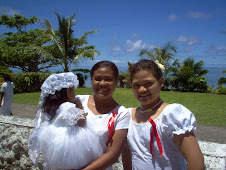
First came the women of the village walking across the malae singing in their matching blue puletasi (dresses) with red flowers. Some had flowers in their hair, others had fragrant leis around their necks. Their beautiful voices blended together in harmony and wafted across to us on the cool early morning breeze. The elder men of the village laid the fala papa (woven mats) on the grass across from us and took their places according to rank. The high orator of the village began to speak with his ceremonial whisk over his shoulder and his talking staff held firmly in his hand. Although at this point I can understand some of the language, one didn't need to know any of the words to understand the honor that was being bestowed upon us. Then came six young men of the village carrying a bamboo platform covered with banana leaves with a huge whole roasted pig cooked that morning in the umu (underground oven). Next other young men of the village brought woven palm leaf baskets with smaller roasted pigs and other food. And then they laid banana leaves on the grass in front of us and four young men came walking toward us with the head and front and hind quarters of a just-butcherd cow slung over their shoulders with blood running down their backs they laid it in front of us. They gave us a cow! In local tradition that is a tremendous honor. And then the women brought out expertly woven fine mats and laid them in front of us.
This small group of sixteen people who have arrived in the country only three months ago to do our best to help where we can have been so blessed to be in the village of Manunu for these past few weeks. Each of us has acquired a new Samoan family and an entire community to call our home whenever we want to return.
We sat cross-legged, Samoan style on our fala mat, awestruck with the gratitude that was begin expressed to us, when it is we who cannot express enough gratitude to the families that took us into their homes, welcomed us with open arms, taught us the Samoan language and the Samoan way of life, and provided us with food, shelter and alofa for seven weeks. To say that none of us, the people of Manunu or the Pisikoa, will ever forget this experience of the past few weeks is an understatement I am sure. The people of Manunu will tell the story over the years about the palangi who lived with them once upon a time with whom they laughed and played and who they took into their hearts. And each of us will have stories to tell our grandchildren about how we once lived in a Samoan village and taught them how to play softball, sang in the church choir, danced the siva, killed a chicken for dinner, climbed a coconut tree, had a beau with whom we sat and talked under the stars, made coconut cream from a fresh coconut, swam in the pool by the waterfall, lived in a little thatched-roof hut, had a chicken lay an egg at the foot of the bed, walked each morning in the dew-laden grass to the open fale for classes each day, or had the honor of a holding a precious baby girl in your arms who was named for you.
_________________________________________
And this is just beginning! Next week we each go to a new village to begin our "real" Peace Corps experience.
It is absolutely amazing to realize that we have nearly completed our training, and be sworn in as official Peace Corps volunteers on Wednesday. It has been tough, but has gone by so quickly. We are in for a big change that will be perhaps more challenging than what we’ve experienced thus far. Going to our new villages on August 23rd and adapting to a new lifestyle - no more structured training calendars, meeting a whole village of new people, and starting the "job" part of our Peace Corps experience will be difficult in many ways. Nonetheless, we have gotten this far and have been given tools to use. That’s what the sometimes grueling training has been for.
Last Sunday morning the congregation of the church in our training village began to say goodbye to us. I read in Samoan, a prayer of thanks. Compared to the few words I was able to say on that very first Sunday here, even I am impressed with my abilities. (I passed our final language test at the advanced level last week - I was pleasantly surprised.) Like on our first Sunday, when we we all went to the front of the church to be welcomed, we did that again. Only this time we knew everyone who gave us a hug or a lei. It was a beautiful and moving service and I couldn’t help but shed a few tears.
Of course none of this could have happened without the village of Manunu. (Each new group of volunteers goes to a different village in Samoa for their training village.) We are each going to desperately miss our families here. I have been given an incredible honor. Baby Urima will also be given the name of Donna. I am nearly moved to tears each time I think of it. All the rest of her life she will know that she was named for this palagi (a generic term for white person - not used derisively) who once came to live with the family for a few short weeks.
We have been told by the trainers and current PC volunteers that we are having a very special experience in Manunu. Never before has a Peace Corps training group been so warmly welcomed into the whole community and made a real part of the village. We have been part of the lotu (church services), had sivas (dances) thrown just for us, and I think our goodbye fiafia (village celebration with traditional dance, etc.) next week will be a hard act to follow. It is a physically beautiful village nestled in the mountains. The traditional village structure with the homes in a circular pattern and the malae in the middle (grassy "village square" where the young people play rugby and soccer and village gatherings are held) make not only a picturesque setting, but an remarkable social network of families, Samoan style. They have literally and figuratively surrounded us with their love and kindness.
The village itself has also told us how much we will missed and that we have made a difference by being here. This week, one of the chiefs told us that for some of the people in Manunu this has been one of the happiest times of their lives. Amazing!
August 18, 2007
First came the women of the village walking across the malae singing in their matching blue puletasi (dresses) with red flowers. Some had flowers in their hair, others had fragrant leis around their necks. Their beautiful voices blended together in harmony and wafted across to us on the cool early morning breeze. The elder men of the village laid the fala papa (woven mats) on the grass across from us and took their places according to rank. The high orator of the village began to speak with his ceremonial whisk over his shoulder and his talking staff held firmly in his hand. Although at this point I can understand some of the language, one didn't need to know any of the words to understand the honor that was being bestowed upon us. Then came six young men of the village carrying a bamboo platform covered with banana leaves with a huge whole roasted pig cooked that morning in the umu (underground oven). Next other young men of the village brought woven palm leaf baskets with smaller roasted pigs and other food. And then they laid banana leaves on the grass in front of us and four young men came walking toward us with the head and front and hind quarters of a just-butcherd cow slung over their shoulders with blood running down their backs they laid it in front of us. They gave us a cow! In local tradition that is a tremendous honor. And then the women brought out expertly woven fine mats and laid them in front of us.
This small group of sixteen people who have arrived in the country only three months ago to do our best to help where we can have been so blessed to be in the village of Manunu for these past few weeks. Each of us has acquired a new Samoan family and an entire community to call our home whenever we want to return.
We sat cross-legged, Samoan style on our fala mat, awestruck with the gratitude that was begin expressed to us, when it is we who cannot express enough gratitude to the families that took us into their homes, welcomed us with open arms, taught us the Samoan language and the Samoan way of life, and provided us with food, shelter and alofa for seven weeks. To say that none of us, the people of Manunu or the Pisikoa, will ever forget this experience of the past few weeks is an understatement I am sure. The people of Manunu will tell the story over the years about the palangi who lived with them once upon a time with whom they laughed and played and who they took into their hearts. And each of us will have stories to tell our grandchildren about how we once lived in a Samoan village and taught them how to play softball, sang in the church choir, danced the siva, killed a chicken for dinner, climbed a coconut tree, had a beau with whom we sat and talked under the stars, made coconut cream from a fresh coconut, swam in the pool by the waterfall, lived in a little thatched-roof hut, had a chicken lay an egg at the foot of the bed, walked each morning in the dew-laden grass to the open fale for classes each day, or had the honor of a holding a precious baby girl in your arms who was named for you.
_________________________________________
And this is just beginning! Next week we each go to a new village to begin our "real" Peace Corps experience.
Subscribe to:
Posts (Atom)









.jpg)