Thursday, December 31, 2009


HAWAI'I CALLS
Gardenias' fragrances float in the tropical air.
Breezes sigh in the ironwood trees.
Spring moon is shining full.
Frogs call and crickets chirp.
As the moon pulls on the tides tonight
Drawing them closer to her,
I feel Hawai'i tugging on my soul,
Drawing me closer to her.
Islands of gentle showers and soft green,
Pahoehoe and a'a,
Mountains soaring, rivers roaring,
Forests of rain, and deep waters.
I need to be comforted by your softness,
Challenged by your rugged solitude,
And nestled in your warm bosom,
Renewed and held in the spell of your tropical nights.
Friday, December 25, 2009
Back to the Islands
On January 7th I'll finally be settling in back on the Big Island of Hawaii. I miss the island life and am getting anxious to be back. I hope to travel to Samoa in the spring.
Manuia le Kirisimasi, Mele Kalikimaka, Merry, Merry Christmas to all!
Manuia le Kirisimasi, Mele Kalikimaka, Merry, Merry Christmas to all!
Life Goes On
It’s been nearly three months since the tsunami in Samoa. The immediate crisis is past. Houses and lives are being rebuilt. Here’s the email I recently received from my Samoan family:
Dear Donna,
Sorry for delaying in replying your Email. Kids are very happy with
their gifts. We also very happy and would like to thank you very much
indeed for all this you have done for us. Hemara is very like to write to you.
Regarding Tsunami, We are now starting to plan for a new house at the
roadside. I am trying to get some money loan from the Bank to add on the
assistance given by the government, then probably starting the
construction work by next month.
Best regards from Saina, Hemara, Tia and Fetu
Tofa Soifua
Lesaisaea Niualuga
When a Peace Corps volunteer in Samoa is assigned to a village, it’s the responsibility of the village to provide a place for the volunteer to live. I had initially been told, as I had requested, that I would have a place by myself. I was dismayed to learn just a few days before I went to Poutasi that I would be living with a family in the village.
As a group of 16 volunteers we had gone through training together for three months. Then we were taken to our individual villages. I vividly remember that day when we arrived in Poutasi and I was introduced to my Samoan family. Then the Peace Corps vehicle drove away and there I was. In a strange house, with people I didn’t know. I don’t know that I’ve ever felt so alone.
But sometimes we don’t know what’s best for us. When it was time to come back to the States the next year, it was so hard to leave my Samoan family. We hugged and kissed and cried together. I know for a fact that my experience there was enriched immensely by having been a part of this family.
In Samoa, as in all of Polynesia, if you are related by blood (even the remotest cousin), or by adoption (formal or otherwise), or by marriage, or by simply being welcomed into the family, you are family, now and forever.
I lived in Poutasi with Lesaisaea Niualuga Evaimalo, his wife, Saina, and their children. Saina’s father, Tuatagaloa Te’o Fetu, was high chief of Poutasi and the Falealili District (12 villages on the southern coast of the Island of Upolu) for decades. When he passed away in the 1990’s, the family chose a new matai (chief), Joe Annandale, who then became Tuatagaloa Joe Annandale. The Annandale ancestor came to Samoa from Scotland, and in 1873 married a Samoan princess, the niece of King Malietoa.
In Samoa there is what is known as “customary land.” Every Samoan family has a swath of land that runs from the sea to the mountain which has been their family’s land for hundreds of years. They don’t have title to it; they can’t sell it or lease it. It’s the family land. Usually several households live on the family land in individual houses. One family in Poutasi had over 50 family members living together in different houses, including the 80-year-old matriarch of the family and her children and their children and their children.
As I said, Saina’s father was the Tuatagaloa high chief for many years. After her father’s death, her mother moved to Apia to live with family there. Saina married Niu and they now live in the family house in Poutasi where I stayed. Tuatagaloa Joe, the current high chief, and his wife Tui lived in their house next door.
Saina and Niu's have six children. Three of them lived with us in Poutasi. Their oldest daughter is grown with a family of her own. Son Stephen is attending high school in California and lives with family there, and daughter Aileen lived with her aunt and uncle in Apia. Throughout Polynesia children are commonly entrusted to relatives. In America we associate foster parenting or adoption with something gone wrong. In Samoa it's like a redistribution of children, to those with no children, or to a family who might be able to provide more ample means of support. These transfers of children aren’t absolute, and although the fosterage may last for years, they don’t permanently separate the children from their biological parents, who have a deep and lasting commitment to their children. It’s hard for us to understand, and likewise, the thought that we have orphanages is appalling to Samoans.
(Aileen is now attending Alabama State University in Montgomery on scholarship and I was able to spend some time with her when visiting my son in Atlanta for Thanksgiving.)
The younger children in our family, Hemara, Tia, and Fetu, lived with us in Poutasi. Hemara and Tia, attended St. Mary’s Primary School, a private school in Apia. Hemara turned 11 soon after I got there and is now 13. She and I became especially close. Youngest son, Fetu, has a learning disability (Saina has diabetes, which was diagnosed during her pregnancy with Fetu, and such high risk pregnancies often result in developmental delay, learning difficulties and ADHD). When I first came to the village, Fetu, at age 7, was not attending school at all. They had tried to send him to the local school, but teachers in Samoan village schools don't have the training to deal with such a situation. I encouraged and worked with Saina, and we were able about one year later to get Fetu into a private school in Apia, where he would get the extra help he needed. It’s very fortunate that the family has the resources to send the children to private schools. If not, Fetu would just not have gone to school.
My Samoan family is wealthy by Samoan standards. Saina’s family owns a bakery, small grocery store, and restaurant in Apia. Saina works at the store. Niu was originally from another village. (In Samoa you don’t marry someone from your own village.) He got his Bachelor’s degree from the University of the South Pacific in Fiji in Environmental Science. When I first arrived in the village, Niu was in charge of the National Park in Samoa. While I was there he got a promotion and he is now head of Waste Management for the Ministry of Natural Resources and Environment. Joe and Tui owned Sinalei (http://www.sinalei.ws/), a small resort a few miles away, which was a real treat for me to visit occasionally. (Both the Ministry and the resort have internet access so we can continue to keep in touch via email.)
Because of the wealth and the status of my Samoan family, I felt kind of guilty at first that my life was cushier and more comfortable than most of the other Peace Corps volunteers in country. But after a time, I realized that this was my Peace Corps experience, and other volunteers would have a different experience, and that was okay.
And of course it’s all still relative. We lived in one of the nicest houses in the village. But we still had no hot water, and cold water intermittently. The family did most of the cooking over an open fire in the cookhouse out back, since we had only a one-burner propane cook top in the house, and no stove. We had a refrigerator when I first moved there, but it died about three months before I left and hadn’t been replaced yet. The laundry was done either at the sink, which was outside next to the house, or in buckets in the shower stall.
Well, I digress. My Samoan family is doing well under the circumstances. Joe is recovering from his injuries and plans to repair and reopen Sinalei by April 2010. Tui will be missed forever, but Joe has a lot of family support. I talked to Niu and Saina by telephone several days after the tsunami. Their new house will be located on family land away from the ocean front and along the government road slightly higher in elevation. The children are doing well. Saina said that Hemara was angry because she had written a letter to me which hadn’t yet been mailed, and it was washed away.
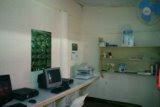
I haven’t worked out the details yet, but I am continuing to plan to raise some money to reopen the homework center/computer center. I was so pleased that they had kept it going after I left, and even added another room for a quiet study area and library. If I could raise enough money (probably about $2,000 to do repairs and replace the computers), I’d like to go back for a few weeks next spring or summer and set it up again. I’m waiting to hear back from Joe and Niu about the structural integrity of the church hall. The computer center was in the back of the building; the front was badly damaged. There is one other building in the village that is a possible location, but it would need much more repair.
Geography Postscript
After the tsunami I had questions from a number of you about the size of the Samoan Islands. Here’s a bit of information about Samoa and American Samoa. The eastern group of islands, the territory of American Samoa, has a population of about 55,000. The total land area of American Samoa is 77 square miles made up of seven very small islands. The largest island (Tutuila) has a land area of 57 square miles. It also has a large natural harbor (Pago Pago), which is why the United States wanted it for a naval re-fueling station.
Forty-miles away is the independent country of Samoa (formerly known as Western Samoa) with a total population of about 188,000 and a total land area of 1,133 square miles. Comparatively, the area occupied by Samoa is slightly smaller than the State of Rhode Island. There are four inhabited islands. I lived on the Island of Upolu which is 430 square miles. It’s the most populated island and second largest island, 47 miles long and 15 miles wide. There is one city on the island, Apia (pop. 61,900), which is really an agglomeration of small villages. Seventy percent of the population lives in small villages on the coast.
Dear Donna,
Sorry for delaying in replying your Email. Kids are very happy with
their gifts. We also very happy and would like to thank you very much
indeed for all this you have done for us. Hemara is very like to write to you.
Regarding Tsunami, We are now starting to plan for a new house at the
roadside. I am trying to get some money loan from the Bank to add on the
assistance given by the government, then probably starting the
construction work by next month.
Best regards from Saina, Hemara, Tia and Fetu
Tofa Soifua
Lesaisaea Niualuga
When a Peace Corps volunteer in Samoa is assigned to a village, it’s the responsibility of the village to provide a place for the volunteer to live. I had initially been told, as I had requested, that I would have a place by myself. I was dismayed to learn just a few days before I went to Poutasi that I would be living with a family in the village.
As a group of 16 volunteers we had gone through training together for three months. Then we were taken to our individual villages. I vividly remember that day when we arrived in Poutasi and I was introduced to my Samoan family. Then the Peace Corps vehicle drove away and there I was. In a strange house, with people I didn’t know. I don’t know that I’ve ever felt so alone.
But sometimes we don’t know what’s best for us. When it was time to come back to the States the next year, it was so hard to leave my Samoan family. We hugged and kissed and cried together. I know for a fact that my experience there was enriched immensely by having been a part of this family.
In Samoa, as in all of Polynesia, if you are related by blood (even the remotest cousin), or by adoption (formal or otherwise), or by marriage, or by simply being welcomed into the family, you are family, now and forever.
I lived in Poutasi with Lesaisaea Niualuga Evaimalo, his wife, Saina, and their children. Saina’s father, Tuatagaloa Te’o Fetu, was high chief of Poutasi and the Falealili District (12 villages on the southern coast of the Island of Upolu) for decades. When he passed away in the 1990’s, the family chose a new matai (chief), Joe Annandale, who then became Tuatagaloa Joe Annandale. The Annandale ancestor came to Samoa from Scotland, and in 1873 married a Samoan princess, the niece of King Malietoa.
In Samoa there is what is known as “customary land.” Every Samoan family has a swath of land that runs from the sea to the mountain which has been their family’s land for hundreds of years. They don’t have title to it; they can’t sell it or lease it. It’s the family land. Usually several households live on the family land in individual houses. One family in Poutasi had over 50 family members living together in different houses, including the 80-year-old matriarch of the family and her children and their children and their children.
As I said, Saina’s father was the Tuatagaloa high chief for many years. After her father’s death, her mother moved to Apia to live with family there. Saina married Niu and they now live in the family house in Poutasi where I stayed. Tuatagaloa Joe, the current high chief, and his wife Tui lived in their house next door.
Saina and Niu's have six children. Three of them lived with us in Poutasi. Their oldest daughter is grown with a family of her own. Son Stephen is attending high school in California and lives with family there, and daughter Aileen lived with her aunt and uncle in Apia. Throughout Polynesia children are commonly entrusted to relatives. In America we associate foster parenting or adoption with something gone wrong. In Samoa it's like a redistribution of children, to those with no children, or to a family who might be able to provide more ample means of support. These transfers of children aren’t absolute, and although the fosterage may last for years, they don’t permanently separate the children from their biological parents, who have a deep and lasting commitment to their children. It’s hard for us to understand, and likewise, the thought that we have orphanages is appalling to Samoans.
(Aileen is now attending Alabama State University in Montgomery on scholarship and I was able to spend some time with her when visiting my son in Atlanta for Thanksgiving.)
The younger children in our family, Hemara, Tia, and Fetu, lived with us in Poutasi. Hemara and Tia, attended St. Mary’s Primary School, a private school in Apia. Hemara turned 11 soon after I got there and is now 13. She and I became especially close. Youngest son, Fetu, has a learning disability (Saina has diabetes, which was diagnosed during her pregnancy with Fetu, and such high risk pregnancies often result in developmental delay, learning difficulties and ADHD). When I first came to the village, Fetu, at age 7, was not attending school at all. They had tried to send him to the local school, but teachers in Samoan village schools don't have the training to deal with such a situation. I encouraged and worked with Saina, and we were able about one year later to get Fetu into a private school in Apia, where he would get the extra help he needed. It’s very fortunate that the family has the resources to send the children to private schools. If not, Fetu would just not have gone to school.
My Samoan family is wealthy by Samoan standards. Saina’s family owns a bakery, small grocery store, and restaurant in Apia. Saina works at the store. Niu was originally from another village. (In Samoa you don’t marry someone from your own village.) He got his Bachelor’s degree from the University of the South Pacific in Fiji in Environmental Science. When I first arrived in the village, Niu was in charge of the National Park in Samoa. While I was there he got a promotion and he is now head of Waste Management for the Ministry of Natural Resources and Environment. Joe and Tui owned Sinalei (http://www.sinalei.ws/), a small resort a few miles away, which was a real treat for me to visit occasionally. (Both the Ministry and the resort have internet access so we can continue to keep in touch via email.)
Because of the wealth and the status of my Samoan family, I felt kind of guilty at first that my life was cushier and more comfortable than most of the other Peace Corps volunteers in country. But after a time, I realized that this was my Peace Corps experience, and other volunteers would have a different experience, and that was okay.
And of course it’s all still relative. We lived in one of the nicest houses in the village. But we still had no hot water, and cold water intermittently. The family did most of the cooking over an open fire in the cookhouse out back, since we had only a one-burner propane cook top in the house, and no stove. We had a refrigerator when I first moved there, but it died about three months before I left and hadn’t been replaced yet. The laundry was done either at the sink, which was outside next to the house, or in buckets in the shower stall.
Well, I digress. My Samoan family is doing well under the circumstances. Joe is recovering from his injuries and plans to repair and reopen Sinalei by April 2010. Tui will be missed forever, but Joe has a lot of family support. I talked to Niu and Saina by telephone several days after the tsunami. Their new house will be located on family land away from the ocean front and along the government road slightly higher in elevation. The children are doing well. Saina said that Hemara was angry because she had written a letter to me which hadn’t yet been mailed, and it was washed away.
I haven’t worked out the details yet, but I am continuing to plan to raise some money to reopen the homework center/computer center. I was so pleased that they had kept it going after I left, and even added another room for a quiet study area and library. If I could raise enough money (probably about $2,000 to do repairs and replace the computers), I’d like to go back for a few weeks next spring or summer and set it up again. I’m waiting to hear back from Joe and Niu about the structural integrity of the church hall. The computer center was in the back of the building; the front was badly damaged. There is one other building in the village that is a possible location, but it would need much more repair.
Geography Postscript
After the tsunami I had questions from a number of you about the size of the Samoan Islands. Here’s a bit of information about Samoa and American Samoa. The eastern group of islands, the territory of American Samoa, has a population of about 55,000. The total land area of American Samoa is 77 square miles made up of seven very small islands. The largest island (Tutuila) has a land area of 57 square miles. It also has a large natural harbor (Pago Pago), which is why the United States wanted it for a naval re-fueling station.
Forty-miles away is the independent country of Samoa (formerly known as Western Samoa) with a total population of about 188,000 and a total land area of 1,133 square miles. Comparatively, the area occupied by Samoa is slightly smaller than the State of Rhode Island. There are four inhabited islands. I lived on the Island of Upolu which is 430 square miles. It’s the most populated island and second largest island, 47 miles long and 15 miles wide. There is one city on the island, Apia (pop. 61,900), which is really an agglomeration of small villages. Seventy percent of the population lives in small villages on the coast.
Sunday, October 25, 2009
Filipo in Happier Times
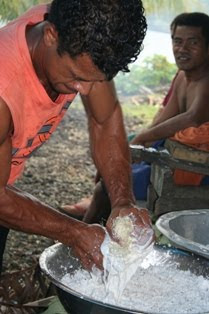
Filipo is the young man in the CNN video below talking about the tsunami in Poutasi. Here are some photos that I took last year of Filipo scraping the skin off a breadfruit with a tuna can and making freshly squeezed coconut milk for a village celebration.


New Posts to Come
I'm waiting to hear back from Poutasi to see if they would like to rebuild the homework center. The church hall (the homework center was in a former store room in the back of the church hall) is damaged in the front of the building, but the building still stands. If it is structurally sound, I would like to raise funds to restore the computer/homework center and go back to facilitate that happening next year.
It's been an interesting year. A good year with lots of travels - but not in the South Pacific. There is definitely a readjustment process returning home from Peace Corps.
I'll be back in Hawaii soon and will post more about all of the above and more.
It's been an interesting year. A good year with lots of travels - but not in the South Pacific. There is definitely a readjustment process returning home from Peace Corps.
I'll be back in Hawaii soon and will post more about all of the above and more.
Thursday, October 1, 2009
TSUNAMI IN SAMOA!!
PART I
By now most everyone has heard about the earthquake and tsunami that hit Samoa and American Samoa on Tuesday, September 29th. The quake, with a magnitude between 8.0 and 8.3, struck at 6.48 am Samoan time on Tuesday and locals said it lasted up to three minutes. According to news reports, eyewitnesses said that over the next 20 minutes there were four giant walls of water, between three and nine meters high.
It's very hard to get news. The phones don't work. But I have heard via email that my village of Poutasi was one of the hardest hit. Initial reports are that it was devastated, flattened. One Peace Corps volunteer in country says that there are possibly 50 dead in Poutasi (in a village of 325 people). I heard by email from the Peace Corps country director that one of my family members was killed. Her body was found washed up in a tree after she tried to help some children get to safety. I don't know yet if the others are safe.
It’s hard to describe to someone who hasn’t had the experience what it means to live in a Samoan village with a Samoan family for 18 months. You’re out of your comfort zone, far away from what you know. They take you in and love you. It was my village, my home, my family. I know everyone in the village and they know me. I was their pisikoa.
I’ve kept in touch with my Samoan family since I came back. The father of the family works for a government ministry and has email at his office. Hemara, the 12-year old daughter, who is very dear to me, sends me letters, and just last week I sent a box of gifts for the children in my family for White Sunday (Children’s Day – the second Sunday in October).
I'm a weeping mess. It will be a very hard day again today. I slept very little. Every time I closed my eyes I could only see my beautiful village as it was, and imagine what must have happened. And I see the children of the village, and know that their lives are changed forever.
PART II
Fa'afetai tele ia le Atua mo le puipuiga o lo'u aiga Samoa. (Thank God for the protection of my Samoan family.)
I was able to contact a Peace Corps volunteer in country who contacted Niu's workplace where someone said that Niu, Saina and the children are safe. Niu, Saina and the kids are the nuclear family in whose home I lived in Poutasi. Tuatagaloa Joe and his wife Tui are cousins who lived in the house next door to us. Joe is the chief of our extended family, and also the high chief of the village and the entire district made up of several villages. Joe is in the hospital in critical condition.
Tui was killed in the tsunami. She and I were good friends. She was close to me in age, of German and Samoan heritage. She was educated in New Zealand and spoke English very well. She had many "Western ways," and yet was thoroughly Samoan. We often sat on her deck overlooking the ocean and had a cup of tea together. She was very well known and respected throughout the islands. If you Google her name you will find much has been published already about her death. Here's an excerpt from one of them:
Former Miss Samoa Tui Annandale, wasn't one of the lucky ones. Annandale and her husband Joe were having morning prayers at home in the village of Poutasi when the earthquake struck. Annandale tried to flee the wave by car, but she was sucked out and drowned.
Tui's funeral, held on Wednesday night, was attended by Samoa's Prime Minister, the head of state and also former rugby player and relative, Peter Fatialofa.
Tui's friend Leiloa was on foot behind the car and miraculously lived. "The wave picked me up and threw me into the church. I held onto the pillar until the water passed," she says.
By now most everyone has heard about the earthquake and tsunami that hit Samoa and American Samoa on Tuesday, September 29th. The quake, with a magnitude between 8.0 and 8.3, struck at 6.48 am Samoan time on Tuesday and locals said it lasted up to three minutes. According to news reports, eyewitnesses said that over the next 20 minutes there were four giant walls of water, between three and nine meters high.
It's very hard to get news. The phones don't work. But I have heard via email that my village of Poutasi was one of the hardest hit. Initial reports are that it was devastated, flattened. One Peace Corps volunteer in country says that there are possibly 50 dead in Poutasi (in a village of 325 people). I heard by email from the Peace Corps country director that one of my family members was killed. Her body was found washed up in a tree after she tried to help some children get to safety. I don't know yet if the others are safe.
It’s hard to describe to someone who hasn’t had the experience what it means to live in a Samoan village with a Samoan family for 18 months. You’re out of your comfort zone, far away from what you know. They take you in and love you. It was my village, my home, my family. I know everyone in the village and they know me. I was their pisikoa.
I’ve kept in touch with my Samoan family since I came back. The father of the family works for a government ministry and has email at his office. Hemara, the 12-year old daughter, who is very dear to me, sends me letters, and just last week I sent a box of gifts for the children in my family for White Sunday (Children’s Day – the second Sunday in October).
I'm a weeping mess. It will be a very hard day again today. I slept very little. Every time I closed my eyes I could only see my beautiful village as it was, and imagine what must have happened. And I see the children of the village, and know that their lives are changed forever.
PART II
Fa'afetai tele ia le Atua mo le puipuiga o lo'u aiga Samoa. (Thank God for the protection of my Samoan family.)
I was able to contact a Peace Corps volunteer in country who contacted Niu's workplace where someone said that Niu, Saina and the children are safe. Niu, Saina and the kids are the nuclear family in whose home I lived in Poutasi. Tuatagaloa Joe and his wife Tui are cousins who lived in the house next door to us. Joe is the chief of our extended family, and also the high chief of the village and the entire district made up of several villages. Joe is in the hospital in critical condition.
Tui was killed in the tsunami. She and I were good friends. She was close to me in age, of German and Samoan heritage. She was educated in New Zealand and spoke English very well. She had many "Western ways," and yet was thoroughly Samoan. We often sat on her deck overlooking the ocean and had a cup of tea together. She was very well known and respected throughout the islands. If you Google her name you will find much has been published already about her death. Here's an excerpt from one of them:
Former Miss Samoa Tui Annandale, wasn't one of the lucky ones. Annandale and her husband Joe were having morning prayers at home in the village of Poutasi when the earthquake struck. Annandale tried to flee the wave by car, but she was sucked out and drowned.
Tui's funeral, held on Wednesday night, was attended by Samoa's Prime Minister, the head of state and also former rugby player and relative, Peter Fatialofa.
Tui's friend Leiloa was on foot behind the car and miraculously lived. "The wave picked me up and threw me into the church. I held onto the pillar until the water passed," she says.
Wednesday, November 19, 2008
Home Is Where The Heart Is
Life has often been compared to a journey, and like a journey, we never know what we will find around the next bend in the road. My assignment with Peace Corps in Samoa was scheduled to conclude in the summer of 2009, but I will be leaving a few months early. The primary reason that I’m leaving is to be with my mother in Colorado as she undergoes surgery for a condition in her lower back that is causing her to experience severe pain. For months she has tried cortisone injections, chiropractors, various pain medications, etc. with no relief. Not only will she need someone to be there to help her when she returns home from the hospital, but obviously I want to be there with her during the surgery as well. It’s curious what turns our lives take sometimes. To be honest with you my dear friends and family, lately my thoughts have been turning more and more toward going home. And then my mother’s surgery comes, and it’s time to go home.
Perhaps this will come as a surprise to some of you because I have tried to keep an optimistic outlook and upbeat attitude during my time here. But damn it’s hard sometimes! Peace Corps life is supposed to be a challenge and it is. But not in the ways that I thought it would be. Of course there are the language and culture challenges, which one expects. However, I would say that the biggest challenge has been the loneliness.
Even though I am surrounded by people who are kind and supportive here in my village, and even though there are other Peace Corps volunteers with whom I interact on a regular basis, it gets lonely. I miss having close friends and family nearby to laugh with, talk about the events of the day, and to share life with. When I was in Hawaii, even though I was in the middle of the Pacific Ocean, I had friends and family there. I had occasional visitors from the mainland, and I came back to Colorado to visit. And most of all, I could pick up my cell phone and talk to anyone for however long I wanted. That’s one of the hardest parts about being physically separated from friends and family. I’m lucky that I’m in Samoa at a time when there are internet connections and even cell phones here in country. That makes keeping contact much easier. But it’s prohibitively expensive to talk like we do back home. So I have conversations with my kids and my mother maybe once a month, all the time being aware of the cost and the time, and I try to keep up with others by email. It’s just not the same.
I will have accomplished what I came here to do – travel to new places, have an adventure, and hopefully make a positive contribution. I know that the kids whom I’ve taught in our little computer center will always remember me. Maybe as that funny old lady, but nonetheless, they will remember. And I can’t tell you how exciting and rewarding it is to see a 12-year old kid who had never seen a computer six months ago, walk into the center, turn on the computer, open up the program he wants to use, work on a project, open his file on the computer, save it, and move on to the next thing. Yesterday I had 20 kids there over the space of nearly three hours taking turns on our three computers.
My village of Poutasi is beautiful in many ways. Together we have done some positive things that hopefully will continue to evolve after I leave, but no matter how long I stayed I could never "finish" what I started. There would always be something more to do, even if I stayed here five years.
Mom’s surgery is scheduled for December 3, so I plan to come home by Thanksgiving. I'll continue to post blogs about my remaining time here in Samoa and the challenges as I adjust to life back in the States, which is part of my Peace Corps experience as well.
It will be good to be home.
Perhaps this will come as a surprise to some of you because I have tried to keep an optimistic outlook and upbeat attitude during my time here. But damn it’s hard sometimes! Peace Corps life is supposed to be a challenge and it is. But not in the ways that I thought it would be. Of course there are the language and culture challenges, which one expects. However, I would say that the biggest challenge has been the loneliness.
Even though I am surrounded by people who are kind and supportive here in my village, and even though there are other Peace Corps volunteers with whom I interact on a regular basis, it gets lonely. I miss having close friends and family nearby to laugh with, talk about the events of the day, and to share life with. When I was in Hawaii, even though I was in the middle of the Pacific Ocean, I had friends and family there. I had occasional visitors from the mainland, and I came back to Colorado to visit. And most of all, I could pick up my cell phone and talk to anyone for however long I wanted. That’s one of the hardest parts about being physically separated from friends and family. I’m lucky that I’m in Samoa at a time when there are internet connections and even cell phones here in country. That makes keeping contact much easier. But it’s prohibitively expensive to talk like we do back home. So I have conversations with my kids and my mother maybe once a month, all the time being aware of the cost and the time, and I try to keep up with others by email. It’s just not the same.
I will have accomplished what I came here to do – travel to new places, have an adventure, and hopefully make a positive contribution. I know that the kids whom I’ve taught in our little computer center will always remember me. Maybe as that funny old lady, but nonetheless, they will remember. And I can’t tell you how exciting and rewarding it is to see a 12-year old kid who had never seen a computer six months ago, walk into the center, turn on the computer, open up the program he wants to use, work on a project, open his file on the computer, save it, and move on to the next thing. Yesterday I had 20 kids there over the space of nearly three hours taking turns on our three computers.
My village of Poutasi is beautiful in many ways. Together we have done some positive things that hopefully will continue to evolve after I leave, but no matter how long I stayed I could never "finish" what I started. There would always be something more to do, even if I stayed here five years.
Mom’s surgery is scheduled for December 3, so I plan to come home by Thanksgiving. I'll continue to post blogs about my remaining time here in Samoa and the challenges as I adjust to life back in the States, which is part of my Peace Corps experience as well.
It will be good to be home.
Wednesday, October 8, 2008
A Tattoo!
 I got a tattoo. There are not many Polynesian words that have entered the English language, but perhaps the most widely used is tattoo. Exactly where and when the word "tattoo" originated is open to debate, but it is certain that it was a corruption of the Polynesian word tatau, picked up by the early European sailors exploring the Southern Ocean.
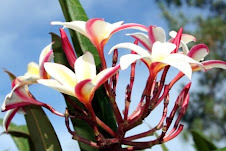
I suppose that this is a good time to tell you that my tattoo is a small frangipani flower on the back of my right shoulder. It is lovely, but not conspicuous, especially compared to traditional Samoan tattoos. Of course not every Peace Corps volunteer in Samoa gets a tattoo, but a significant number of every group do so. Our Peace Corps Medical Officer even has a particular tattoo shop that she recommends.
Most Peace Corps volunteers opt for something traditional in design, emulating the tattoos that Samoan men and
blog.jpg) women wear, though somewhat less extensive. And most volunteers get their tattoos using the traditional tattooing implements – pointed metal combs (made of bone in the old days) dipped in ink and tapped into the skin with a wooden mallet.
women wear, though somewhat less extensive. And most volunteers get their tattoos using the traditional tattooing implements – pointed metal combs (made of bone in the old days) dipped in ink and tapped into the skin with a wooden mallet.I had the tattoo artist use his electric instruments because I wanted color which can’t be done with the traditional tools. It’s light red and yellow, just like a frangipani flower, with a black border design. I went in with an idea of what I wanted, and together with the tattooist, we came up with the finished pattern. It took only about a half hour. And yes, it hurt, but more at first. You kind of get used to it as it progresses, and I quickly figured out that it helped to take my mind away from the fact that I was getting punctured with needles to something else more pleasant.
 Nearly all Samoan men and women have tattoos. It’s been part of their culture for centuries. Many have smaller tattoos, but the most traditional tattoos for men cover their bodies from their bellies to mid-thigh. The ink coverage is so extensive, and the design so intricate, that on first glance it looks like they are wearing very tight pants. The ships’ logs of many early explorers commented upon the presence of “britches” upon Samoan males. This type of tattoo is called a pe’a (pay´-uh) and needless to say it’s very painful. I’ve watched them do it. The master tattooist is assisted by up to six helpers all of whom wish to become masters themselves. One will be responsible for the mixing of the dyes, another is responsible for wiping away the blood, another for dipping the instruments into the dye and receiving instruments that have been used, another cleans and sharpens the teeth of the metal combs, and another will hold the skin tight. Young women sit by the person being tattooed, holding them down to stop them moving too much and massaging the head. It takes about 40 or 50 hours to do a traditional pe’a in several sessions. And yes, in case you’re wondering, it covers everything.
The tattoos applied to women are smaller and more delicate. The traditional ones cover an area wrapping around both thighs about ten inches in length. It’s called a malu.
It’s just one more thing that makes life in Samoa very interesting indeed.
Subscribe to:
Posts (Atom)








.jpg)